
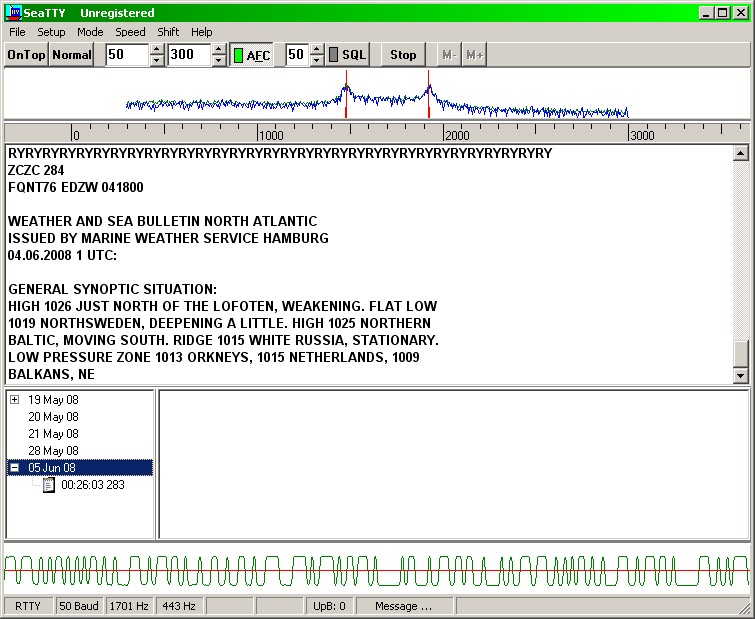
Here is my first reception of an RTTY signal transmitting weather forecast.
TX station: Marine Weather Service – Hamburg, Germany
Frequency: 10100.8 kHz
Way of transmission: RTTY, speed 50 baud, shift 450 Hz
RX location: Oulu, Finland
Receiver: Degen DE1103
Antenna: Shortwave active loop antenna placed indoor close to a window towards SW
SINPO: 43443
Decoder: SeaTTY software, line-out of the receiver connected to mic-in of a laptop
Despite the interference coming from the laptop (the LCD screen creates really bad interference through the audio cable), the reception was really good.
Sieee.
Poi da Amburgo, capito!
Fo un po’ di spamme.
(il preview ‘un funge)
Sì, ma poi a 50 baud, ti rendi conto? il Marine Weather Service di Amburgo è uno dei pochi che mantiene il servizio in RTTY sulle onde corte. La maggior parte di questi servizi è stata terminata a causa delle nuove tecnologie. Dice infatti che una rete chiamata Internet permetta velocità molto più elevate, e con una migliore affidabilità rispetto alla trasmissione in onde corte.
PS: prova a lasciare un messaggio ora 🙂
I think that you may shield your audio cable with a split ferrite core, like this.
It’s cheap and it works!
Actually I’ve bought a ground loop isolator, a device that separates the ground of the radio from the laptop. It doesn’t make a big difference. My opinion is that my laptop is bad (actually it is 🙂 ), concerning RF interference. The LCD screen and the hard disk are also bad sources of noise.
Awaiting for the ASUS eee 901 to be released, with that one it’ll be another story!
Ouch!
If the interference comes from the cable itself you may filter with a low pass filter, since you need low freq audio and the LCD will be presumably above 100kHz (my guess is that the noise comes from the inverter).
—-/////—-o—–
|
—
—
|
—- GND
the cutoff freq (-3dB) is 1/sqrt(RC). You’ll have to adjust the values to an appropriate freq and low resistance (but then you need a high enough capacitance!).
Actually the sources of interference are two: one on RF (the screen, for example, increases the noise of the received signal in the radio, also with the audio cable unplugged), one through the cable when plugged. One possible explanation for the latter is that the laptop doesn’t have a line-in, but only mic-in, which makes me thing that that input is active (amplified), thus the increased noise. With a ground isolator that should be solved, though. But it isn’t.
Again! You plug the audio output of your radio to the line-in (mic-in) of your computer. Does the radio get audible interference? Or is just the signal into the computer that is noisy. Let’s for a moment forget the RF noise radiated from the screen.
The radio gets back interference from the laptop. If I switch off the LCD screen, the interference disappear. Furthermore, also the laptop charger makes interference. Actually I have to work on battery, otherwise I can’t hear anything from the radio. All this when the audio cable is plugged, of course.
There is a discussion going on in the DE1103 forum: also there they say to separate the grounds. I start to wonder whether the ground loop separator I bought is not working properly. I might buy the stuff and build it by myself 🙂
Looks to me that this is a mere interference by means of the cable rather than a ground loop. To test this it’s sufficient to operate the radio on batteries and/or the laptop.
I would try with a low pass filter. I do this on my experiment.
Yep. Actually I could easily make a low pass filter with 20/30 kHz cut-off frequency, or even less, since the transmission bandwidth is just 4 kHz. I’ll let you know. Didn’t know you were interested in this kind of stuff!
Well, that’s what I’ve been doing lately in my job: removing ground loops and noise. So now I reached a ~10 nV noise on my sample and I removed the ground loop that caused a signal few orders of magnitude larger that what I measure now.
And I like to fix this kind of things: I’m not an expert in electronics, but I like when I manage to do what I want!
Moi!
Minkälainen aktiiviantenni sulla oli tässä..?
t. Antti
Semmoinen Degen DE31 active loop. Häiriötä tulee kuitenkin myös käyttämällä pitkää lankaa antennina